Promoting and Sustaining Resilience in Anchor Institutions

In the U.S. it is often said that “all response is local” – at least initially.

The first time I truly understood this was an internal conference of a large federal agency convened to consider lessons from the response to 2005’s Hurricane Katrina. One speaker, a confident, seasoned, burly ex-fire fighter, recounted being among the first federal responders to arrive at a mass shelter site at the New Orleans stadium and conference center. Conditions in these sites had been grim, with sweltering heat, and shortages of reliable power, working sanitation, food, and water. The speaker choked back tears as he recounted the anger and desperation of local responders who wondered “Where were you?!” as they had been left on their own to care for thousands evacuees, many of them medically fragile. The event underscored that resilience needs to be multi-level, blending efforts of individuals, households, community organizations, and local, regional, national and cross-national-level governments.

I’ve spent much of the two decades since working to foster community anchor institutions’ ability to help foster community to natural disasters, terrorist attacks, large-scale accidents, disease outbreaks, and other threats. Anchor institutions are large, locally-rooted organizations such as hospitals, universities, schools, businesses, and libraries that  possess staff, space, equipment, and relationships that make them natural hubs for building and sharing capability across a community.

Over the years that work revealed four major challenges in disaster preparedness relevant to those preparing their communities to be resilient in the face of a wide range of risks. 

The first is the important distinction between capacity (possessing the staff, space, stuff, plans, and materiel for response) and capability (the ability to use those capacities in realistic, stressful, dynamic situations. I own five musical instruments (capacity), but that is no guarantee that I can play them well, play them in an ensemble, and improvise when needed (capability).   

Even in small countries, however, there is often considerable variation in community culture, language, infrastructure, geography, and other factors. Thus, increasing the number of individuals, households and communities engaged in resilience activities often requires adapting practices to fit with local context. 

Resilience often involves adapting to rapidly changing conditions. Most people are familiar with the Ukrainian military and defense industrial complex’s high-tempo efforts to adapt first-person drones and other technologies to stay one step ahead of an adaptive adversary. The same holds for local communities and institutions, who must also build a similar type of agility.  

Communities typically have limited resources to put together resilience-building activities. Even in the U.S. – overall an incredibly wealthy country—some 37 percent of households report not being able to cover a $400 unplanned expense, and state and local preparedness activities remain heavily-dependent on federal subsidies. Resilience-strengthening tools need to be lean and low-cost.

Over the years, my teams and I developed and implemented range of simple, user-friendly tools for testing and improving front-line operational capabilities that remains sensitive to local variation and cost constraints and helps strengthen connectivity across anchor institutions. I illustrate with reference to a tool for ongoing testing and improvement of hospital surge capacity: the ability to maintain adequate medical evaluation and care during events that exceed the limits of the normal medical infrastructure.

The first step is to identify a full range of response activities required by various attack vectors. But instead of focusing obsessively on the details of each scenario, we identify common-mode, modular elements (think Lego blocks) that are common to many of them. For hospitals, one is the ability to clear emergency departments to make room for disaster patients.

Second, we select a small number of these Lego building blocks and developed small, user-friendly, low-cost exercise modules around them that allow staff and stakeholders to run semi-realistic tests of them. 

In the hospital surge exercise assessors present to the emergency department (ideally without prior warning), inform them that this is a drill, and then proceed to provide ED leaders with a series of short disaster patient scenarios (e.g., Female, 40 years old, unresponsive; Male, 56 years old, amputation, etc.), with the flow rate designed to match typical patterns in real mass casualty incidents.

Keeping the burdens low encourages hospitals to use the tool for ongoing quality-improvement cycles, where initial runs are used to identify gaps, followed by efforts to plug the gaps and retest to see whether these and other gaps remain.

Hospitals are encouraged to use peer assessors from neighboring hospitals, which reduces cost and some of the “evaluation anxiety” associated with evaluations by official government inspections, and helps facilitating the spread of ideas and resources during a disaster. 

This general approach might have promise for improving resilience in other anchor institutions such as schools, local businesses, churches, and other civic organizations. It is not a replacement for household level resilience-building but can be part of an integrated multi-level approach.

The 2012 film Red Tails recounts the story of the Tuskegee Airmen, a squadron of African American fighter pilots who protected Allied bombers and fought the Nazi Luftwaffe over Europe during World War II. In a closing scene, one character observes: “Experience is a hard teacher because she gives the test first, the lesson afterward." Low-cost, modular exercises for the front lines provide a way to simulate some of those tests early on so communities can get the lessons in time to prepare us for the big real-world tests to come.
Resilience Begins with Civic Participation and the Ability to Cooperate

Resilience — a society's timely preparedness, its ability to withstand and recover from any crisis, including military attack — also depends on an active civil society, since in recent decades our understanding of resilience has shifted from a "top-down" approach to a "bottom-up" one, which places greater responsibility on individuals, communities and the wider civil society for matters relating to security and defence. The civic aspects of resilience discussed in this article are analysed in detail in my publication "The Civic Dimension of Resilience: The Case of Latvia and Finland," a chapter in the 2026 volume edited by Rasa Smaliukienė, David Schultz and Vidmantė Giedraitytė, "Democratic Resilience in the Baltics, Vol. 2: Societal Resilience as a Defensive Power," which offers a broad and comprehensive study of the concept of resilience in the context of Baltic security.

Four areas can be identified within the civic dimension of resilience that deserve attention when considering society's capacity for self-organisation, as well as strong state–society relations in crisis situations. Within each of these areas it is possible to define clear, measurable indicators to assess the civic aspects of societal resilience, both in comparison with other countries and over time, making it possible to manage these intangible yet no less essential resilience factors in a targeted way. First, resilience depends on society's knowledge and skills for how to act in emergency situations, as well as on each citizen's individual understanding of national security and national defence and their own role within it. This aspect is shaped both by civic education at the general-education level and by the strategic communication of the institutions responsible for public security.

Social relationships are the second area characterising societal resilience in its civic dimension, fostered by strong social ties, local community cooperation networks and individually built social capital, social cohesion and the capacity for self-organisation to address specific issues, civic and political participation, and a sense of belonging to the local community, region and state. A society with these characteristics can overcome crises more quickly and effectively, since it has access not only to support from the relevant state and municipal institutions but also to the diverse resources available to the community itself, such as knowledge and skills, technological equipment, funding and more. Social trust, sense of belonging, and the level of civic and political participation are among the indicators regularly measured in various cross-country studies, which in turn makes it possible to assess the social-relations aspect within the context of resilience as well.

Governance culture and quality at the national and municipal levels are also linked to resilience, as they determine the ability of civil society and governing institutions to cooperate effectively during crises. This is shaped by effective, transparent, inclusive and accountable governance and leadership, democratic discussion and deliberation in addressing issues of public importance, equal access to social and welfare services, a culture of mutual trust and dialogue, and citizens' trust in officials and institutions. These aspects of the civic dimension of resilience are characterised by indicators such as political trust, public satisfaction with the political system, and citizens' willingness to defend the country in the event of a military attack — which in turn depends heavily on political factors and on society's assessment of how well politicians' decisions and actions align with the public interest and the common good.

Finally, society's ability to act effectively in crises also depends on the timely, accurate and sufficient flow of information, which is why information and communication form another area to be considered within the civic aspect of resilience. For this area to function effectively, a range of literacies related to the information space are needed, such as media literacy. From a civic standpoint, the cognitive dimension of the information space — that is, society's beliefs and attitudes that shape behaviour — is of primary importance. In this respect, education in the broad sense plays a very significant role, as it equips people with the knowledge and skills needed not only to assess processes within the media and social-media space, but also to critically evaluate the content of information — something possible only if a person understands basic principles relating to politics, health, finance and other areas essential to the life of society and the individual.

In the publication "The Civic Dimension of Resilience: The Case of Latvia and Finland," all of the civic-dimension resilience indicators listed above are analysed comparatively between Latvia and Finland. Analysis of secondary data shows that Finland's civil-society development indicators are higher than Latvia's. The comparison of the civic aspects of resilience in Finland and Latvia shows that Finland has higher emergency preparedness, more active interaction between society and responsible institutions, a slightly higher awareness of Russia as a security threat, higher social trust and civic and political participation, an equally high sense of local and national belonging, higher political trust and evaluation of the political system, significantly higher willingness to defend the country, and higher media literacy. Given that Finland is a country with one of the best-developed models of comprehensive national defence — one that Latvia has itself used as an example and a benchmark — the article's most significant conclusion is that the effective functioning of this model is also closely tied to a broad set of social and political factors, which must likewise be taken into account when considering national security and national defence.

Link to the article.

Link to the book.

Inoculating Society Against Fear-Mongering

In the Baltic region, long exposure to existential risk has created a specialized fluency in threat perception. We continuously track uncrewed drones, severed undersea cables, signal jamming, and military force movements. What we nameless frequently, however, is that fear itself is an operational payload – and that the patriotic rhetoric capable of mobilizing a nation to defend itself can, in the wrong hands, be turned to stampede it.
Two distinct concepts, rarely examined together, explain why this happens.

The first is securitization. Developed by the Copenhagen School of international relations, its insight is deceptively simple: security is not merely a fact but a claim. When a politician, a media outlet, or a hostile online channel declares something an existential threat, they are doing more than describing reality; they are making a demand upon us.

They are requesting permission to bypass standard political debate, concentrate executive power, and normalise emergency measures that citizens would reject in ordinary times. The move succeeds only if the audience grants that permission. Fear is the primary currency in which that permission is paid.

The second concept is psychological inoculation. Over six decades ago, the psychologist William McGuire demonstrated that beliefs, like human bodies, can be immunised against subversion. Expose someone to a weakened version of a manipulative argument – along with the tools needed to dismantle it – and they build cognitive antibodies. When the full-strength campaign arrives, it no longer takes hold. Modern researchers call this preventive process "prebunking," and it succeeds precisely because prior warning changes how we process information. A manipulation we see coming loses most of its coercive power.

Combine these two insights and a vital conclusion emerges. If securitization depends on audience acceptance, then the public is not a passive bystander. It is the decisive actor.

A populace taught in advance how fearmongering is constructed becomes exceptionally difficult to stampede.
This principle matters deeply in the Baltic states, where nuance must be preserved against broad cynicism. Facing genuine and documented security challenges, we cannot afford the casual skepticism that dismisses every warning as political trickery. Yet we are also permanent targets of information campaigns designed explicitly to manufacture dread – to make our communities feel helpless, portray defense as provocation, and convince minority groups that they are under siege.

Fear is not an accidental byproduct of these operations; fear is the explicit objective. A population that cannot easily be frightened is not showing weakness dressed as resilience; it is providing a strategic asset. It represents total defense extended into the mind.

What, then, does inoculation actually teach? It teaches citizens not to disbelieve, but to recognize a technique. Fear-mongering relies on a remarkably consistent grammar: the framing of every debate as an existential crisis; the artificial sense of urgency claiming there is no time to think; the demand that we surrender judgment to self-proclaimed protectors; the enemy drawn as monstrous rather than merely dangerous; and the quiet assertion that disagreement equals disloyalty.

Teach citizens to spot these mechanisms and you provide them with a mental filter that operates automatically – one that flags manipulation regardless of the flag it flies under.

This final point is uncomfortable, yet it is what makes the argument honest rather than convenient. The same rhetorical grammar can be spoken by an adversary or by a friend. A hostile channel uses it to spread panic; a domestic actor may be tempted to use it to win a political debate or push through measures that could not survive open scrutiny. Inoculation takes no side between them.

It offers citizens a clear standard that authentic security communication can meet and manipulation cannot: genuine threat messaging relies on evidence, remains proportionate, invites public scrutiny, and treats citizens as rational agents who can handle the truth. Manipulation offers panic instead of proof and obedience instead of judgment.

For those who work in defense communication, this analytical awareness is not a threat to the mission. It is the mission itself, properly understood.

A public that can distinguish a genuine warning from a manufactured scare is far more resilient in a real crisis, because its trust has been earned rather than extracted. Fear commands obedience only until its mechanisms are understood.

The Baltic experience has given us hard-won skill in reading external threats. Our next obligation is to share the antidote – to cultivate a generation that encounters the language of fear as an immunized body encounters a virus: alert, composed, and already immune.

Building Real Connections Between Latvia and Ireland

For me, the connection between Latvia and Ireland has never been just about trade statistics or formal agreements—it is about people, trust, and shared ambition. This belief has shaped my journey for almost 15 years, including my role as one of the founders of the Irish Latvian Chamber of Commerce (ILCC).

The idea for ILCC was born in 2011. At the time, the Latvia–Ireland relationship was full of potential but lacked a structured platform to bring people and businesses together. We ultimately chose to register ILCC in Latvia on 25 April 2012. From the beginning, it was built as a bridge between two countries.

Over the years, that bridge has grown far beyond traditional trade. I have learned that strong economic relationships are rooted in human connection and are often strengthened through culture, education, and shared experiences.

We have organised initiatives in both Latvia and Ireland, including “Latvian Days in Ireland” from 2015 to 2018 and again in 2023. One particularly memorable example came in 2017, during Zemgale Days in Ireland, when I introduced Latvian musician Gunārs Meijers to Skārleta Mukāne and Noel Lyons of LatWest. His songs were translated into English, performed by Noel Lyons, and released as a CD. It was a powerful reminder that meaningful partnerships often begin outside traditional business settings.

The same philosophy has been at the heart of our 101 CONTACTS – Networking Evening. For more than a decade, with some interruptions, these events have brought people together in informal yet purposeful settings. They have never been simply about exchanging business cards, but about creating conversations from which relationships can grow.

Today, ILCC’s role has become more practical. We continue to organise networking and business events, but increasingly our focus is on creating concrete opportunities for companies to enter markets, meet potential partners and develop international cooperation. In 2026, this has included international chamber cooperation, the Connected Routes event on transport and trade, and joint networking initiatives with other international business organisations in Latvia.

Trade missions remain an important part of our work. We have led numerous Latvian business missions to Ireland, helping companies explore the market and build partnerships. In 2026, this is developing further through our September programme in Ireland and an October Latvia IT, AI and FinTech business delegation to Dublin. At the same time, we are working in the opposite direction—bringing Irish tourism and technology interests to Latvia and creating opportunities for Irish companies to discover Latvia as a business destination.

This two-way movement reflects how much the relationship has matured. What was once largely a one-way perspective—Latvian companies looking towards Ireland—has become a more balanced exchange. Irish companies increasingly recognise Latvia as a reliable and innovative EU partner, while Latvian companies see Ireland not only as an export market but also as a gateway to wider international networks.

There are clear complementarities between our economies. Latvia has strong capabilities in timber construction, manufacturing, tourism and digital services, while Ireland offers a globally connected business environment and extensive experience in technology and innovation. The opportunity today is therefore not simply to increase trade, but to build investments, projects, partnerships and knowledge exchange around these strengths.

Looking ahead, I see significant untapped potential: more two-way investment, stronger company-to-company cooperation, closer links between business and education, and greater use of the Latvian diaspora in Ireland as a bridge for international growth. We also need to give more Irish companies the opportunity to discover Latvia—not only as a market, but as a place to invest, innovate, and build partnerships.

As ILCC approaches its 15th anniversary in 2027, I see an opportunity to reflect on what has been achieved and, more importantly, on what comes next. The Chamber is evolving from simply connecting two countries to helping create a dynamic international business community around them.

My vision is for the Latvia–Ireland relationship to become truly strategic—built on long-term collaboration, shared value, and trust. ILCC will continue to connect people, open doors, and turn first conversations into lasting partnerships.

Because in the end, everything starts with a connection—and the right connection can change everything.

Mobilising civil society also means capital and captains of industry.

In the late 1930s the business model was primarily vested in a national market – you operated in a town, region, city or at most national landscape. The titans of industry were men (just about always men) who sat at the top of social orders that were national in nature and shaped by national narratives. You were an American Company (even if you felt you were Texan or MidWest or cosmopolitan Manhattan), an Australian outfit (either a subsidiary of a British firm or a local home grown product behind protectionist trade barriers) or maybe a Canadian concern driven by the exploitation of huge natural resources, growing labour availability and progressive confidence in a Dominion that was asserting its unique story. Transnational or global was the rare exception like Coca Cola, Ford or BP… and the cultural mindset was still nationalistic.

Survivors from the Edwardian era of mechanical and technological innovation, from the trenches of Polygon Wood, Vimy Ridge or Gallipoli, and the global depression that gave free trade, international markets and free flow of capital a bad name. You were not capitalists or managers of capital of anywhere – you were citizens, community leaders and stewards of precious capital from somewhere. Customers, investors or critics shared your shared citizenship.

Take us 95 years or just three generations to now, and we are in a business environment where the product is designed in Seattle, manufactured in Shenzhen, shipped to Sydney, used by a backpacker from Sherbrooke with profits eventually distributed to pension funds in Stuttgart, Sheffield and Seoul. Global markets have risen because of technology, access, and trade since the end of the Cold War.

Nationalism is dead… so we thought. Everyone was a student of the “end of history” and reveled in the consumption of the same products, listening to the same music, driven by the same social media and embracing the “one world” viewpoint of unimportant borders, broad live and let live attitudes followed by a blurring of differences in political systems and their redundant values.

But then reality struck: we had invasions of territory by Russia, cyber trolling of opinions across national boundaries, the buying of influence in political parties across Western democracies by “new money” friends of authoritarian regimes, bullying of universities that offered platforms to critics of the authorities in Beijing, St Petersburg, Havana, Pyongyang or Ramallah. All in a decade post the global financial crisis when North American, Australian or European corporations were struggling to return to acceptable returns on investment, productivity or capital. Boom time followed by the long downturn.

Faced with global debates on gender, climate, diversity, inclusion and redress for past historic injustices, it was easy to think that your market adversaries were just other global corporations, opinion leaders and a media circus of 24 hours coverage. Corporate Social Responsibility is a well established feature of a mature and risk managing enterprise (private, public or charitable). Corporate National Responsibility (giving due regard to the demands and peculiar requirements of the sovereign state giving you your “license to operate”) is something that fails to excite or trigger the Western executive or decision maker.

But an old problem has returned with a vengeance from the Cold War era: efforts by nations that have differing concepts of what capitalism, markets and freedom are to coerce, constrain, condition western liberal democratic society businesses to their agenda – illiberal, anti-competitive, neglectful of human rights and fundamentally corrosive to the national interests of liberal democracies. Blockades of sea lanes, attacks on undersea cables and assaults on GPS systems are now not "workshop" scenarios.

It is played out in what is alternatively called the “grey zone” conflict and is in the news almost daily. We never fail to notice the allegations of impropriety with decision makers or the questioning of our social cohesion. Yet the main focus to-date of “hybrid warfare” — which uses non-military means to achieve warlike ends — has predominantly been on tactical methods such as cyber attacks, fake news campaigns and espionage. But understanding hybrid warfare’s strategic context equips political and business leaders better to address it.

In simple terms, hybrid warfare uses capabilities not normally associated with war to coerce or subvert. Such techniques are intended to delay recognition that an attack is under way, provoke paralysis in decision making through confusion and discourage the victim from responding forcefully due to the absence of “legitimate” military targets. China, Russia (and to lesser degrees Iran and North Korea) are taking on capitalist democracies and hoping to re-make the international political, economic and trade systems through a coordinated hybrid effort that is taking place largely outside the traditional military or diplomatic realms.

BRICS, the emerged Chinese development banking sector, the Belt and Road strategies and vast capital flows by the global wealthy from closed societies into Mayfair, Melbourne, and Manhatten all shape our acceptance that little can be done by tired, tense and politically divided free societies.

The goals of these hybrid efforts appear to harm economic strength; undermine the legitimacy of key institutions such as governance bodies, academia, diplomatic entities and the media; sow social cohesion discord; and weaken the bonds between the nations and international organisations such as NATO. The erosion of economic resilience and the weakening of cultural values are probably the more pressing threats and likely the hardest to reverse once they are accomplished.

Cyber attacks on private companies, state managed infrastructure and core government entities are a chilling example of grey zone warfare: something that sits below the threshold of naked violence or breaches of international law.

With entities as diverse as the National Cyber Security Centre in London, the RCMP in Canada, the FBI in the US and Department of Defence in Australia all giving recent alarms over the threat profile facing civil society (in particular business and political decision makers) from State and State-sponsored interference, the time to plan a modern style of deterrence is long overdue.

Policy voices like the RAND Corporation, the Royal United Services Institute, the Australian Strategic Policy Institute and Canada’s Mackenzie Institute have all pointed towards the growing risk profile posed by hybrid warfare and the corresponding requirement to bolster national responses.

Business is not in the business of defending a nation. But is it is a vital stakeholder in upholding the civic values underpinning its own legal, economic and cultural validation.

Defence, security, intelligence and critical infrastructure leaders operate in an environment where they depend upon the reliability and resilience of private sector entities, their staff, managers and ultimately shareholders. Just as pension funds and mutual investors are long term players in capital markets, business is a long-term stakeholder in the preservation of Western pluralist free societies.

Any security threat is a market challenge just as significant as the climate emergency, mass people movement, unfair trade practices or corruption.

Shareholder value, brand or reputation management all contribute to today’s CEO headaches – but rising competition between great and emerging powers also raises the question: “have we met our corporate sovereign nation responsibilities?”. Consumers and shareholders via the media have plenty of opportunity to pass judgement on corporations that fail the test of public opinion.

Business leaders excel and profit from the freedoms derived from free societies under the rule of law. Defending these societies is no longer a luxury in a world only a few mouse clicks or fake news stories away from harm.

Colonel Michael Dewar in 1989 spoke prior to the end of the Cold War with insight: "Every citizen, be he (sic) neutralist, pacifist or unilateralist, has an interest in the defence of his (sic) homeland". Global thought leader Elisabeth Braw noted in 2021: " ... since the end of the Cold War most Western governments have been wary of asking their citizens for even the most rudimentary contributions to national security".

The strategic communication challenge of 2026 is a whole of society conversation that reaches an audience beyond elites, specialists and technical decision makers. No time to waste.

Resilience Reality Check: Entrepreneurial Preparedness for the First 72 Hours of Crisis

The majority of national security frameworks prioritize individual preparedness, establishing a minimum duration (72 hours to seven days) that a private citizen is expected to survive without state assistance following a significant disruption. But a key question follows: are similar expectations placed on businesses and institutions?

The 72-hour standard was never intended for commercial enterprises because it originated from the household preparedness doctrine. Private companies are well aware of the importance of preparedness, but they have made a rational calculation within a permissive regulatory environment. Compliance costs money today, while noncompliance costs nothing. Investing in resilience incurs immediate, certain, and fully visible costs on a balance sheet, while the costs of failure are future.

Resilience and efficiency are structurally in tension. Secure, locally sourced supply chains are more expensive. "Just-in-case" inventory models tie up capital. Redundant systems, backup power, and cyber-resilient infrastructure all carry direct costs. Secure hardware and software from NATO and EU countries costs more than alternatives sourced outside those alliances. The market will always pressure organizations toward efficiency over redundancy. Expecting businesses to invest in preparedness without addressing this economic reality is wishful thinking.

Certain private companies are obliged to invest in resilience, either by regulation (for instance, critical infrastructure) or by compliance requests from their mother companies or investors.

Critical infrastructure operators are legally required to maintain compliance with security standards and business continuity plans. However, critical infrastructure does not operate in isolation. Most organizations depend on outsourced services, including IT support, physical security, logistics, and maintenance. The resilience of critical infrastructure is therefore inseparable from the resilience of its subcontractors. Many subcontractors hold simultaneous contracts with dozens or hundreds of organizations. If a crisis occurs, all those clients may demand the same service immediately. Can a single security firm guard hundreds of facilities during a hybrid attack? Is it possible for an IT provider to support dozens of clients at once who have been affected by ransomware, as was the case with WannaCry and NotPetya? Can backup generator suppliers deliver to all partners at once, as the 2025 Spain-Portugal electricity crisis demonstrated? This issue of interdependency is not sufficiently addressed in current preparedness frameworks.

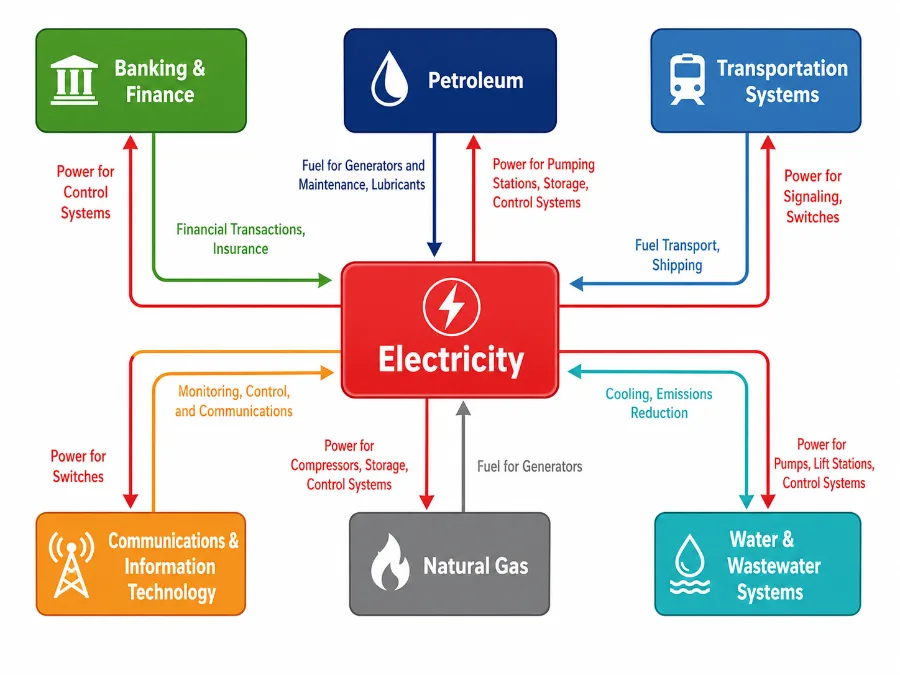
The Nordic-Baltic planning assumption is that if essential services such as electricity, communications, banking, and water remain functional, the private sector will adapt. This has been demonstrated during the pandemic and the war in Ukraine. The EU's Union Preparedness Strategy outlines a meaningful action plan, including minimum preparedness criteria for essential services, stockpiling requirements for critical materials, and mechanisms to secure critical production lines. This is directionally correct. However, implementation will take years. Latvia's private sector needs to be resilient now. The threats are immediate and overlapping. Hybrid warfare is not a future scenario but today's reality, as unmanned aerial incidents have already occurred on Latvian soil. A parallel risk is supply chain fragility, as a US-Iran military conflict could impact Europe's access to critical medicines and manufacturing inputs with little warning.

The 2025 BRELL electricity grid disconnection in the Baltics was a useful stress test. It prompted organizations to update their crisis plans, check their generators, and verify their backup procedures. At the same time, Latvia has introduced so-called Category D critical infrastructure obligations, which primarily target subcontractors of essential service providers and require them to demonstrate preparedness and wartime functionality. Sweden is developing a national standard, SS 22306, for organizational preparedness applicable to both public and private organizations, explicitly designed for use in procurement, meaning that contracting authorities will be able to require demonstrated preparedness as a condition of commercial engagement, measured against actual operational capability.

We see different, fragmented initiatives. What is required is a methodical, ecosystem-level approach to preparedness that includes clear obligations, fair compensation mechanisms, and the genuine integration of the private sector into national security planning. While essential service providers and the CER directive partly cover this, many essential service subcontractors do not have the obligation or resources to invest in security and resiliency. This includes the ability to operate for at least 72 hours during a crisis.

RAINCLOUD UKRAINA: The Strategic Imperative for Ukraine’s Transformation

The reconstruction of Ukraine represents perhaps the most significant economic and humanitarian undertaking of the twenty-first century. To succeed, this massive project requires unprecedented amounts of international private capital to flow into the country. RAINCLOUD UKRAINA is a strategic imperative designed to enable these private financial flows by overcoming information asymmetry, institutional friction, and trust gaps. By providing a secure bridge and a robust due diligence framework for international capital, RAINCLOUD UKRAINA accelerates Ukraine’s transition to a modern, digitally-native European economy.

The transition from post-conflict emergency assistance to a sustainable, modern industrial state is better conceptualized not as mere "recovery," but as a comprehensive socio-economic transformation. Central to this shift is the deployment of digital infrastructure such as RAINCLOUD UKRAINA, which can navigate the complex interplay among international capital, local entrepreneurship, and the persistent institutional legacies of the post-Soviet era.

The institutional architecture of transformation
Ukraine’s current operating environment is a dense, often paralyzing overlap of Soviet-era regulations, post-independence legislation, and nascent EU legal frameworks. This bureaucratic friction, while partly a byproduct of a state at war, serves as a significant deterrent to the large-scale mobilization of foreign private capital. For international investors, the primary barrier is rarely a lack of appetite for risk; rather, it is a lack of institutional visibility and legal clarity. Transparency regarding government contracts, land-use agreements, and regulatory compliance remains fragmented.

In this context, the role of a specialized digital platform like RAINCLOUD UKRAINA becomes an institutional necessity rather than a technological convenience. By serving as an invitation-only, AI-native "operating system" for transformation, the platform addresses the fundamental problem of information asymmetry. It provides a secure bridge between verified Ukrainian partners and international corporations, particularly within high-stakes sectors such as energy, finance, and infrastructure. Such a system does not merely "connect dots"; it establishes the digital "guardrails" necessary to scale innovation without the systemic risks typically associated with disaggregated political and industrial arenas.

The energy sector
Ukraine has transitioned from a pre-war energy capacity of 35 gigawatts to a current output of 9 gigawatts due to systemic targeting of centralized nodes. This systemic vulnerability underscores the long-term strategic imperative: moving away from the centralized Soviet-era grid toward a decentralized, dispersed energy infrastructure. This shift can position Ukraine as a modern, Euro-integrated economy and potential energy exporter to the EU after the war. Achieving this dramatic transformation requires mobilizing private capital for decentralized generation projects that adhere to the "Build Back Better" principles of modern European standards. RAINCLOUD UKRAINA can bridge the "visibility gap" by connecting international firms to granular, decentralized project opportunities and providing the due diligence backbone needed to deploy private investment for this massive modernization effort.

The defense sector
Ukraine’s defense sector has emerged as a laboratory for software-defined systems and "SME agility." Many Ukrainian companies are demonstrating that the future of defense lies in AI-native technology and rapid iteration cycles, "changing software in flight". Yet, these agile startups often lack the outward-facing business structures required to attract Western private equity. RAINCLOUD UKRAINA facilitates "pathfinding," navigating IP protection, export licenses (such as ITAR), and regulatory hurdles, allowing these local innovations to scale into global defense exporters.

The need for due diligence
Linking international capital to Ukraine’s reconstruction and transformation requires trust and transparency. At the practical level, this means putting in place solid risk assessment and due diligence processes. The implementation of Zero Trust architecture within digital platforms is the most viable path toward trust and transparency. By leveraging human-validated verification processes and transparent data modules, RAINCLOUD UKRAINA can provide the due diligence that international HR and legal departments require before authorizing investment.

The "Diia" e-governance ecosystem has already set a global benchmark for "state-as-a-service" innovation. The success of this portal indicates that Ukraine possesses the technical talent pool and the civic readiness for a deeper digital integration. The next phase of this evolution is the expansion from B2C applications to a robust B2B framework that encompasses the private sector’s role in reconstruction and transformation.

Conclusion: beyond the linear recovery
The transformation of Ukraine cannot be achieved through traditional, linear aid models. It requires a "unity of effort" that connects dispersed stakeholders in real time, from private equity and government guarantors to local engineers and regional administrators. Digital platforms like RAINCLOUD UKRAINA offer a mechanism for this connectivity.

As the country prepares for the upcoming Ukraine Recovery Conference 2026, the focus must remain on building a democratic, green, and predictable investment climate. The transition to a "business-dominant environment" is the ultimate guarantee of Ukraine’s long-term sovereignty. By establishing a digital infrastructure that promotes transparency and "connectivity at the speed of relevance," Ukraine does not merely recover from war; it leaps into a future as a vital, digitally-native pillar of the European economy.